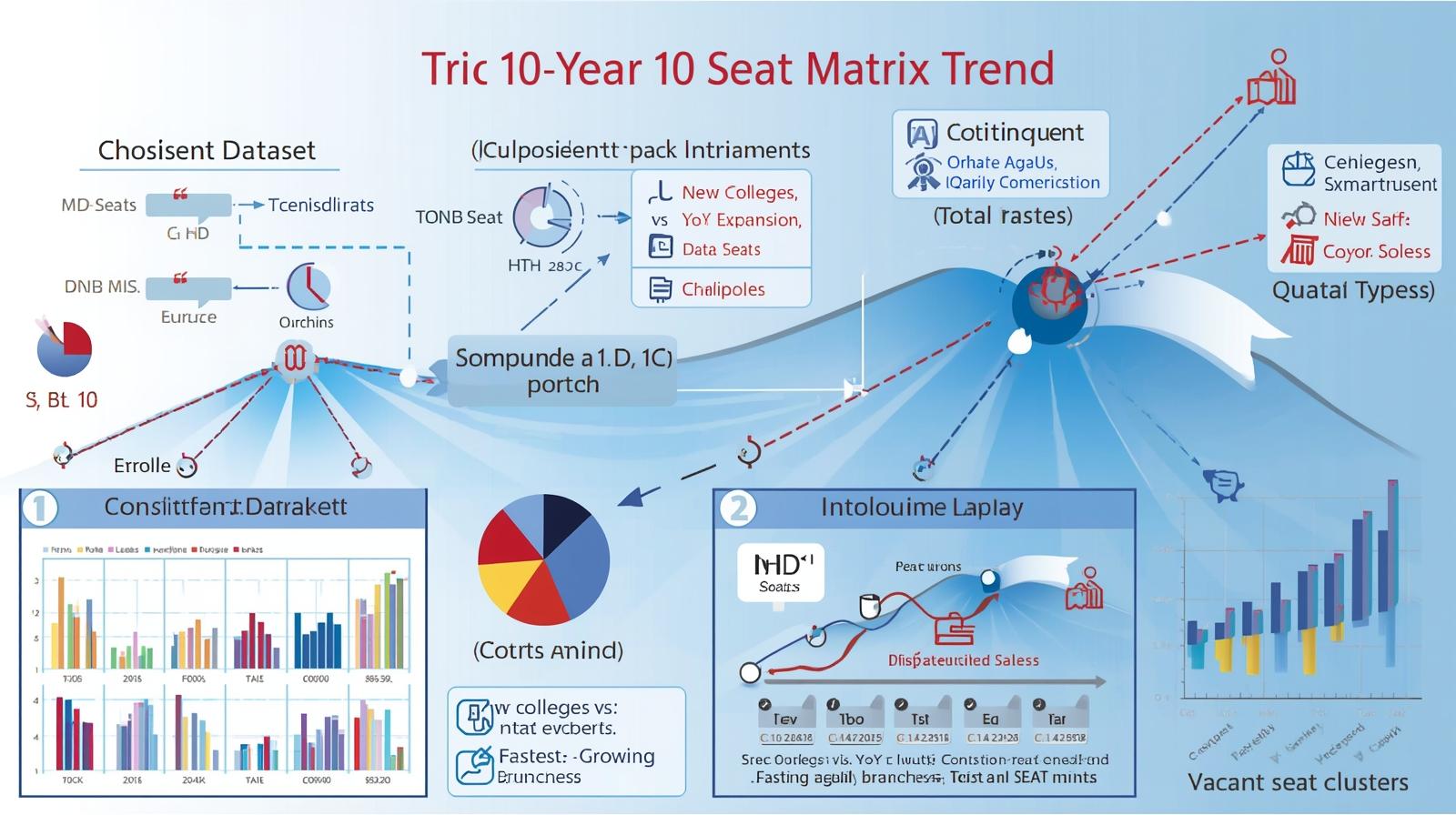
NEET PG Seat Matrix Analysis (Last 10 Years) — What the Data Really Means
First: what “Seat Matrix” actually refers to
In India, “seat matrix” can mean different things depending on the publisher:
-
MCC (DGHS) seat matrix: the seats available in that counselling pool/round (AIQ + deemed + some other participating pools). MCC publishes these round-wise and year-wise.
-
NMC/MARB seat matrix: the approved seats in colleges (often listed as “available seats” as of a date, broad specialty/super specialty etc.).
-
NBEMS/DNB seats: DNB/DrNB seats are tracked separately on NBEMS accreditation portals and counselling handbooks.
So a “last 10 years” analysis must use the same definition across all years, otherwise the trend line becomes misleading.
What we can state confidently from official/near-official reporting
Recent NMC (broad specialty) jump (2024–25 → 2025–26)
A widely reported MARB/NMC update indicates:
-
49,915 PG seats in 2024–2025
-
58,331 PG seats in 2025–2026
-
8,416 seats added in that cycle (broad specialty count as reported).
Long-term growth narrative (pre-2014 → 2023–24)
A commonly cited public summary notes PG seats rising from roughly 31,185 (pre-2014) to 70,645 (2023–24) (but you must verify the exact definition used in each source).
Policy context supporting seat expansion
Government press communications also highlight ongoing seat expansion initiatives (though these cover medical seats broadly, not always PG-only).
NEET PG Seat Matrix Analysis (Last 10 Years)
Trends, Growth & What It Really Means for Aspirants
Every year, thousands of aspirants search:
“Have NEET PG seats increased?”
“Is it easier now compared to 5–10 years ago?”
“Does seat growth improve my chances?”
But the truth is:
Seat growth alone does not tell the full story.
To understand NEET PG properly, you must analyze the seat matrix correctly and interpret it intelligently.
1️⃣ What Is the NEET PG Seat Matrix?
The seat matrix refers to the total number of postgraduate medical seats available in a given academic year, usually categorized by:
-
MD/MS (Broad Speciality)
-
Diploma seats (earlier years)
-
DNB/DrNB seats
-
AIQ (All India Quota)
-
State quota
-
Deemed universities
-
Central institutes
It changes every year due to:
-
New colleges
-
Intake expansion
-
Policy reforms
-
Infrastructure approvals
2️⃣ Has the Seat Matrix Increased in the Last 10 Years?
Yes — significantly.
Over the last decade, India has seen steady growth in PG medical seats due to:
-
Expansion of government medical colleges
-
Conversion of district hospitals into teaching hospitals
-
Increase in specialty seats in anaesthesia, medicine, radiology, and critical care
-
Strengthening of DNB programs in corporate hospitals
This expansion reflects a broader healthcare infrastructure push.
But here’s the important part:
Seat growth does not automatically reduce competition.
Because:
-
MBBS output has also increased
-
More repeaters are appearing every year
-
Coaching penetration has improved preparation quality
3️⃣ Where Has Growth Happened Most?
Broad Specialities
Branches like:
-
General Medicine
-
Anaesthesia
-
Radiodiagnosis
-
Paediatrics
have seen noticeable expansion.
DNB Seats
DNB/DrNB seats have grown significantly due to:
-
Corporate hospital participation
-
Decentralized training model
-
Lower infrastructure requirement compared to full college setup
Deemed Universities
Private sector growth has contributed substantially to overall seat increase.
4️⃣ Does More Seats Mean Easier Admission?
Not necessarily.
Here’s why:
| Factor | Impact |
|---|---|
| Increase in seats | Positive |
| Increase in applicants | Negative |
| Cut-off policy changes | Variable |
| Reservation policy changes | Variable |
| Deemed/private seat cost | Limits accessibility |
If applicants grow faster than seats, competition remains intense.
5️⃣ What Matters More Than Total Seats?
For aspirants, these factors matter more:
🔹 Round 1 Seat Matrix
This shows real initial availability.
🔹 Vacancy Patterns
Which branches remain vacant till later rounds?
🔹 State vs AIQ Distribution
Some states have more opportunities relative to applicant pool.
🔹 Branch-wise Expansion
A branch that increases 30% in seats is more strategically interesting than overall growth of 5%.
6️⃣ Strategic Interpretation for Aspirants
If seats increase in:
-
Anaesthesia → safer backup option
-
DNB → alternative path expands
-
Private/deemed → financial planning becomes key
If growth is mainly in private seats:
Merit competition may not reduce significantly.
If growth is in government AIQ:
Rank advantage improves more meaningfully.
7️⃣ The Real Conclusion
Seat matrix analysis should not be emotional.
It should answer:
-
Which branches are becoming more accessible?
-
Where are seats expanding?
-
What is the long-term trend?
-
How should I adjust my branch strategy?
Final Insight
More seats change strategy.
They don’t remove competition.
NEET PG is not just about rank.
It is about interpreting data smartly.
Suggested
Understand trends. Track data. Choose strategically.
Stay informed for deeper NEET PG insights and counselling analysis.
Practical takeaway for NEET PG aspirants (why this matters)
-
More seats ≠ easier admissions if applicant volume grows faster.
-
But seat expansion can reduce rank pressure in some branches/regions.
-
For counselling strategy, the round-wise seat matrix matters more than the “total approved seats”.