Exam Date: 7 May 2023
Total Marks: 720
Questions: 200 (Attempt 180)
Pattern: Same Section A + Section B format
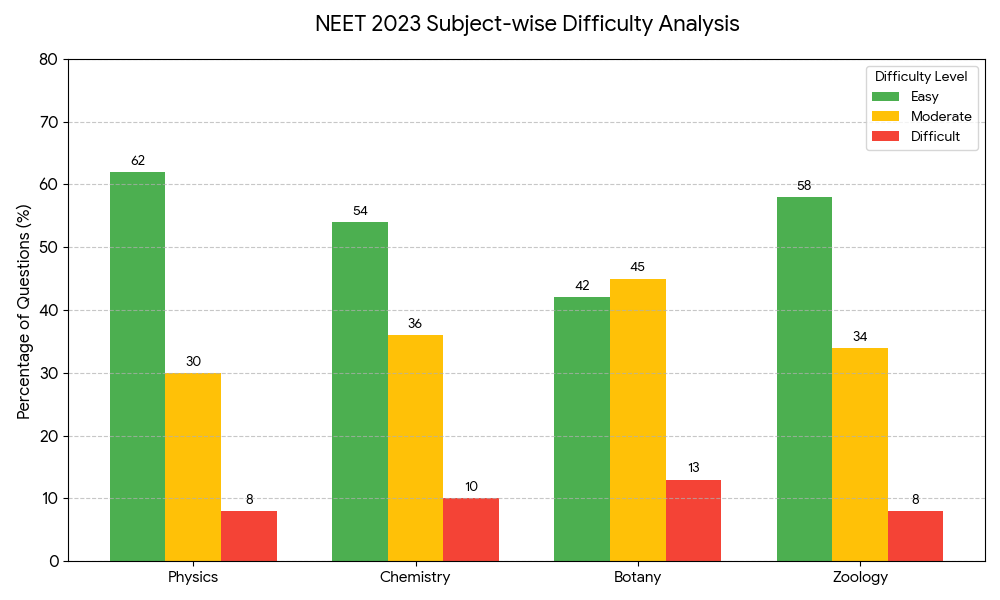
Overall Difficulty
| Subject | Difficulty | Verdict |
|---|---|---|
| Physics | Moderate | Easier than 2022 |
| Chemistry | Moderate | Balanced |
| Biology | Easy → Moderate | NCERT heavy |
| Overall | Moderate | Easier than NEET 2022 |
👉 Paper difficulty returned closer to NEET 2021 level after the tough 2022 paper.
Biggest Shift in NEET 2023
NEET 2022 → Conceptual + Tough
NEET 2023 → Balanced + NCERT-focused
Students found the paper more scoring than 2022.
Physics Analysis (NEET 2023)
Difficulty: Moderate
Physics became less calculation-heavy than 2022.
Chapter Weightage
| Chapter | Questions Trend |
|---|---|
| Modern Physics | Very High |
| Current Electricity | High |
| Magnetism & EMI | High |
| Ray Optics | Moderate |
| Thermodynamics | Moderate |
| Kinematics | Moderate |
Physics Paper Nature
Key trends:
• Formula-based numericals
• Standard NEET pattern questions
• Fewer lengthy calculations
• Direct concept application
👉 Students who practiced PYQs found Physics manageable.
Chemistry Analysis
Difficulty: Moderate (Well-balanced)
Distribution was almost equal across all branches.
| Branch | Weightage |
|---|---|
| Physical | Moderate |
| Organic | High |
| Inorganic | High |
Physical Chemistry
Asked from:
-
Electrochemistry
-
Thermodynamics
-
Solutions
-
Chemical kinetics
Required calculations + formula clarity.
Organic Chemistry
Important chapters:
-
Biomolecules
-
Aldehydes & Ketones
-
Hydrocarbons
-
Amines
More reaction-mechanism questions than 2022.
Inorganic Chemistry
Highly NCERT-based.
Key topics:
-
Chemical bonding
-
Coordination compounds
-
Periodic table
-
p-block elements
👉 Direct line-based questions from NCERT.
Biology Analysis
Difficulty: Easy → Moderate (Scoring Section)
Biology again became very NCERT-centric.
Botany Breakdown
| Unit | Weightage |
|---|---|
| Genetics | Very High |
| Ecology | High |
| Plant Physiology | High |
| Plant Reproduction | Moderate |
Many direct NCERT line questions.
Zoology Breakdown
| Unit | Weightage |
|---|---|
| Human Physiology | Very High |
| Biotechnology | High |
| Reproduction | High |
| Human Health & Disease | High |
Biology Paper Nature
Key trends:
• NCERT statements directly asked
• Diagram-based questions
• Assertion-reason questions
• Less tricky than 2022
👉 Biology again became the highest scoring subject.
Major Paper Trends
1️⃣ NCERT Dominance Returned
Biology & Inorganic were heavily NCERT.
2️⃣ Balanced Paper
No extremely tough section like 2022 Physics.
3️⃣ Speed + Accuracy mattered
Paper rewarded strong basics and practice of PYQs.
Expected Good Score (NEET 2023)
| Marks | Expected Rank |
|---|---|
| 705+ | Top 100 |
| 680+ | < 1000 |
| 650+ | < 5000 |
| 620+ | Govt MBBS chances |
| 580+ | Semi Govt |
Cutoff slightly increased vs 2022 due to easier paper.
NEET 2021 vs 2022 vs 2023 (Trend Snapshot)
| Year | Difficulty | Biology | Physics |
|---|---|---|---|
| 2021 | Moderate | Easy | Moderate |
| 2022 | Tough | Tough | Difficult |
| 2023 | Moderate | Easy-Moderate | Moderate |
Final Verdict
NEET 2023 was a balanced, NCERT-focused paper.
Students who:
-
Mastered NCERT Biology
-
Practiced PYQs
-
Managed time well
👉 Scored high.