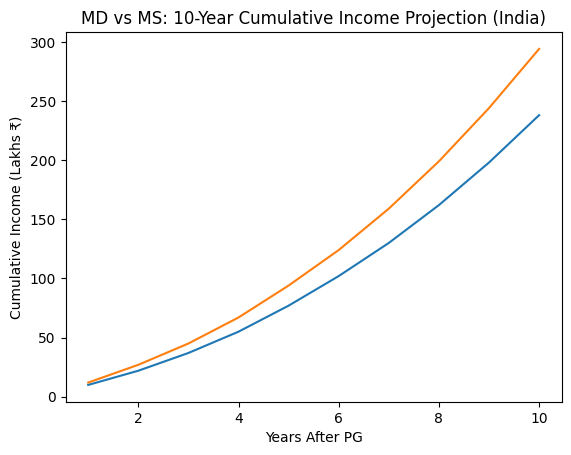
MD vs MS: Income Comparison Over 10 Years (India, 2026)
📈 Key Assumptions
-
Both MD (medical specialist) and MS (surgical specialist) degrees take 3 years postgraduate training after MBBS.
-
Salaries vary widely by sector (government vs private), city, specialisation, and private practice earnings — private practice income isn’t fixed.
💰 Typical Salary Growth: 0–10 Years
| Career Stage | MD (Annual Income) | MS (Annual Income) | Notes |
|---|---|---|---|
| Year 0–3 – PG Residency (MD/MS) | ₹0.5–1.2 LPA (stipend) | ₹0.5–1.2 LPA (stipend) | PG stipend similar during residency |
| Year 3–5 – Early Career | ₹8–15 LPA | ₹9–17 LPA | MS often slightly higher due to surgical premium |
| Year 5–8 – Mid Career Specialist | ₹15–30 LPA | ₹18–35 LPA | Surgical fields may command a higher ceiling |
| Year 8–10 – Experienced Specialist | ₹30–50 LPA+ | ₹35–60 LPA+ | High demand surgeons often earn more especially with private practice |
Note:
• LPA = Lakhs per annum
• These are broad ranges — individual outcomes differ greatly by city, hospital brand, specialist niche, and private consulting/practice revenue.
🧠 What This Means
✔ Residency (Years 0–3)
MD and MS doctors earn similar stipends during training — typically modest, especially in government institutions.
✔ Early Career (Years 3–5)
Post-specialisation, MS doctors often edge slightly higher because:
-
Surgical roles (orthopaedics, general surgery, ENT) tend to attract premium OT shares.
-
Private hospitals may offer higher signing incentives for surgical specialists.
✔ Mid to Experienced Phase (Years 5–10)
Income growth accelerates with:
-
Private practice consultations
-
Procedure/OT shares
-
Reputation and referrals
In this range, MS surgeons typically out-earn MD generalists if they develop a high surgical volume and private practice clientele.
✔ Key Drivers of Higher Income
-
Specialisation niche (e.g., orthopaedic joint replacement vs internal medicine)
-
City economics (metros pay significantly more)
-
Private clinic / consulting practice revenue
-
Super-specialisation (DM/MCh after PG — adds further earning potential)
🧩 Salary Distribution Snapshot (2026 Estimates)
MD Income Examples
-
Radiology, Dermatology: ₹15–30 LPA mid-career
-
General Medicine/Paediatrics: ₹15–25 LPA
MS Income Examples -
Orthopaedics, Plastic Surgery: ₹20–35 LPA mid-career
-
General Surgery/ENT: ₹18–30 LPA
(Ranges overlap and expand with experience and private practice)
📌 Summary: Who Earns More?
| Criteria | Tends to Pay More |
|---|---|
| Early career | ✘ Slight edge to MS |
| Mid career (5–8 yrs) | ✘ Surgical (MS) slightly higher |
| Experienced (8+ yrs) | ✘ MS often outpaces MD if surgical volume & practice build up |
👉 Bottom line: Neither degree guarantees higher pay — but MS (surgical) fields often have a higher earnings ceiling due to procedural fees and OT share, especially in private practice.
🧠 Takeaway for Career Planning
-
Choose MD if you prefer non-surgical specialties like internal medicine, dermatology, or radiology — strong private practice opportunities exist.
-
Choose MS if you want a procedural (surgical) career with potentially higher long-term earnings.
-
Further super-specialisation (DM/MCh) amplifies income potential in both streams.