Clinical vs Non-Clinical Branch: Which Is Financially Better? (India – 2026 Analysis)
For MBBS graduates preparing for NEET PG, this is one of the most practical questions:
Should I choose a clinical branch for higher income, or a non-clinical branch for stability and work-life balance?
The correct answer depends on:
-
Income ceiling
-
Risk tolerance
-
Private practice plans
-
Lifestyle goals
-
Long-term career vision
Let us break it down clearly.
What Is a Clinical Branch?
Clinical branches involve direct patient care.
Examples:
-
MD General Medicine
-
MS General Surgery
-
MD Paediatrics
-
MS Orthopaedics
-
MD Dermatology
-
MD Radiology
These doctors:
-
Run OPDs
-
Perform procedures/surgeries
-
Work in hospitals or private practice
What Is a Non-Clinical Branch?
Non-clinical branches focus on diagnosis, research, teaching, or laboratory sciences.
Examples:
-
MD Pathology
-
MD Microbiology
-
MD Pharmacology
-
MD Anatomy
-
MD Biochemistry
-
MD Community Medicine
These doctors usually:
-
Work in labs
-
Teach in medical colleges
-
Work in public health or pharma
Income Comparison (India – 2026 Practical Ranges)
Early Career (0–3 Years After PG)
| Branch Type | Annual Income |
|---|---|
| Clinical | ₹8–18 LPA |
| Non-Clinical | ₹6–12 LPA |
Clinical branches often start slightly higher due to hospital demand.
Mid Career (5–8 Years)
| Branch Type | Annual Income |
|---|---|
| Clinical | ₹18–40 LPA |
| Non-Clinical | ₹10–20 LPA |
Clinical doctors benefit from:
-
Procedure fees
-
OT share
-
Private consultation
Non-clinical doctors mostly rely on:
-
Fixed salary
-
Academic promotions
10-Year Cumulative Earning Potential
Clinical (Private Practice Model Possible)
₹2–4 Crore cumulative over 10 years
Higher if:
-
Metro city
-
Strong referral network
-
Surgical speciality
Non-Clinical (Academic / Institutional Model)
₹1–2 Crore cumulative over 10 years
More stable but lower ceiling
Why Clinical Branches Earn More
-
Procedural revenue
-
Consultation fees
-
Private practice scalability
-
Hospital incentives
Clinical income grows exponentially once reputation builds.
Why Some Doctors Still Choose Non-Clinical
Because money is not the only metric.
Advantages:
-
Predictable working hours
-
Less medico-legal risk
-
Academic stability
-
Easier work-life balance
For many doctors, this stability is worth the lower ceiling.
Risk vs Reward Analysis
| Factor | Clinical | Non-Clinical |
|---|---|---|
| Income Ceiling | Very High | Moderate |
| Income Stability | Variable | Stable |
| Work Stress | High | Moderate |
| Private Practice | Yes | Limited |
| Work-Life Balance | Challenging | Better |
Who Should Choose Clinical?
Choose clinical if:
-
You want higher financial upside
-
You are comfortable with responsibility
-
You are okay with long hours
-
You want private practice
Who Should Choose Non-Clinical?
Choose non-clinical if:
-
You value lifestyle balance
-
You want academic career
-
You prefer lab/research environment
-
You want lower medico-legal stress
Final Verdict (Financially Speaking)
If the only metric is money, clinical branches generally offer:
-
Higher 10-year cumulative earnings
-
Higher lifetime earning ceiling
-
More scalability
But they also involve:
-
Higher pressure
-
Longer working hours
-
Higher professional risk
Non-clinical branches offer:
-
Stable income
-
Predictable life
-
Lower financial upside
Strategic Advice for NEET PG Aspirants
Do not ask:
Which branch earns more?
Ask instead:
Which branch fits my personality, stress tolerance, and long-term financial strategy?
Because the highest income always goes to:
-
The most competent
-
The most consistent
-
The most market-aware doctor
Not just the branch.

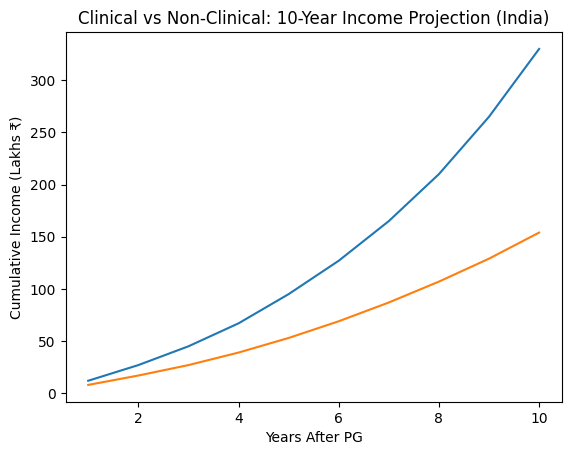
Here is the 10-year cumulative income projection graph for Clinical vs Non-Clinical branches (India model).
📊 Interpretation
By Year 10:
-
Clinical cumulative ≈ ₹330 Lakhs (₹3.3 Cr)
-
Non-Clinical cumulative ≈ ₹155 Lakhs (₹1.55 Cr)
-
Gap ≈ ₹1.75 Crore over 10 years (under moderate private growth assumptions)
Why the gap widens:
-
Clinical income accelerates after Year 5 due to:
-
Procedure revenue
-
OT share
-
Private consultation scaling
-
-
Non-clinical remains mostly fixed-salary driven with slower increments.