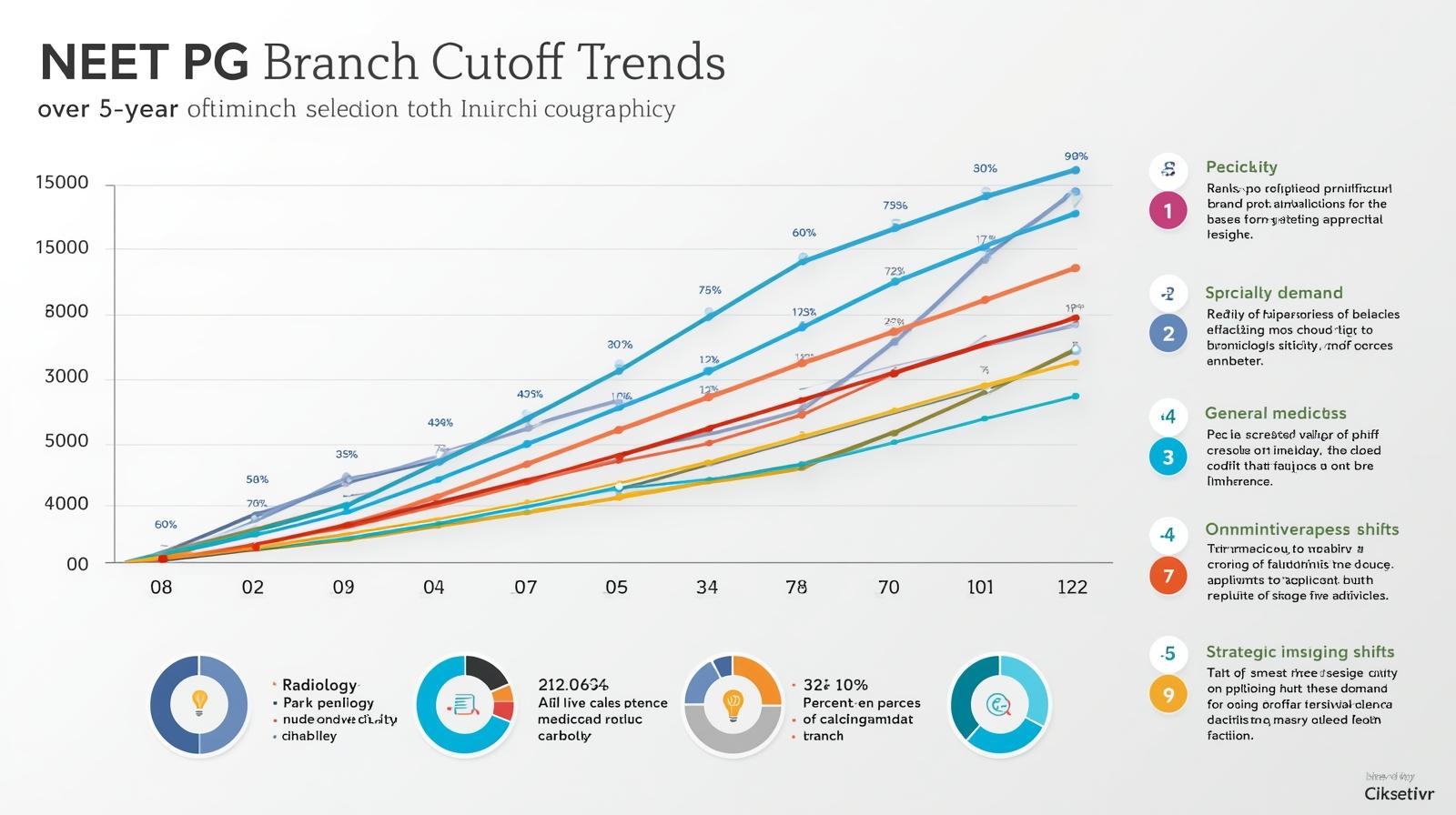
Branch Cutoff Trends – 5 Year Data Study (NEET PG)
Every NEET PG aspirant asks:
“What was the cutoff last year?”
“Is Radiology becoming harder?”
“Is Anaesthesia safer now?”
But looking at one year cutoff is misleading.
The correct way is to study 5-year trend movement — not isolated ranks.
1️⃣ What Does “Branch Cutoff” Actually Mean?
Branch cutoff refers to:
-
Closing rank at which the last seat of a particular branch was allotted
-
Usually analyzed for:
-
All India Quota (AIQ)
-
Top government colleges
-
Deemed universities
-
DNB programs
-
Cutoffs vary by:
-
Category
-
College reputation
-
Round (R1 vs R2 vs Mop-up)
For proper analysis, always use:
AIQ Round 1 General category closing rank as baseline.
2️⃣ 5-Year Trend Observation (2021–2025 Pattern Overview)
🔴 High-Demand Branches (Consistently Tight Cutoffs)
-
Radiodiagnosis
-
Dermatology
-
General Medicine
-
Orthopaedics
Trend pattern:
-
Closing ranks moving higher (more competitive)
-
Very stable demand
-
Minimal fluctuation even when seats increase
Reason:
-
Lifestyle + income balance
-
High ROI potential
-
Private practice scalability
🟡 Moderately Competitive Branches
-
Paediatrics
-
Anaesthesia
-
Obstetrics & Gynaecology
-
ENT
Trend pattern:
-
Gradual fluctuation
-
Sensitive to seat expansion
-
Slight easing when new seats added
Reason:
-
Demand stable but not exploding
-
Workload intensity affects preference
🟢 Relatively Flexible Cutoff Branches
-
Pathology
-
Microbiology
-
Pharmacology
-
Community Medicine
Trend pattern:
-
Higher closing ranks
-
Larger movement year to year
-
Sensitive to counselling strategy
Reason:
-
Non-clinical preference smaller
-
Lifestyle vs income trade-off
3️⃣ What Has Changed in Last 5 Years?
🔹 DNB Cutoffs Improving
Due to:
-
Corporate hospital exposure
-
Better recognition
-
Increasing aspirant confidence
🔹 Deemed Universities More Competitive
As aspirants prioritize:
-
Location
-
Infrastructure
-
Brand value
🔹 Radiology & Dermatology Demand Surge
Despite seat expansion, demand growth matched supply.
4️⃣ Key Cutoff Dynamics You Must Understand
Cutoff = Supply vs Demand Equation
If:
-
Seats ↑ but Applicants ↑↑ → Cutoff unchanged
-
Seats ↑↑ but Applicants stable → Cutoff relaxes
-
Policy change (cutoff percentile reduction) → Temporary distortion
5️⃣ How to Study Cutoffs Correctly
Instead of asking:
“What is safe rank?”
Ask:
-
What was 5-year median closing rank?
-
What was lowest fluctuation year?
-
What happens when percentile drops?
-
How does mop-up differ from Round 1?
6️⃣ Practical Strategy for Aspirants
If Your Rank Is:
-
Top 5,000 → High competition branches realistic
-
5,000–15,000 → Moderate branches strategic
-
15,000+ → Smart state strategy + DNB options
But always track:
-
Seat matrix expansion
-
Branch popularity shifts
-
Counselling round behavior
7️⃣ The Core Insight
Cutoffs don’t move randomly.
They respond to:
-
Income perception
-
Lifestyle trends
-
Migration opportunities
-
Social media influence
-
Pandemic effects (critical care interest surge)
Final Takeaway
Branch selection is not just about passion.
It is about trend awareness + risk assessment.
Study 5-year data.
Not last-year hype.
Suggested
Track trends. Decode cutoffs. Choose strategically.
Stay tuned for deeper NEET PG counselling intelligence.